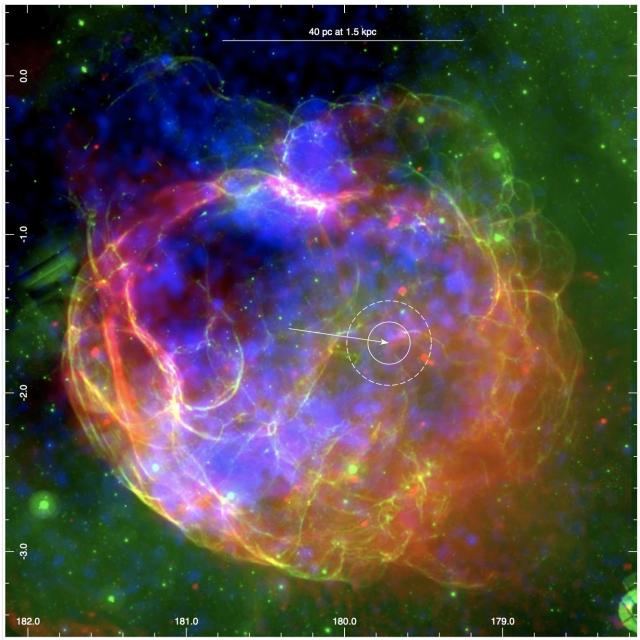



Anisotropic Stellar Wind In the Most Reknown Microquasar In Milky Way New model developed by IKI scientists and their colleagues from Ioffe Institute sheds new light on the origin of W50 giant radio nebula, which hides the most reknown X-ray object of our Galaxy – SS433 microquasar.
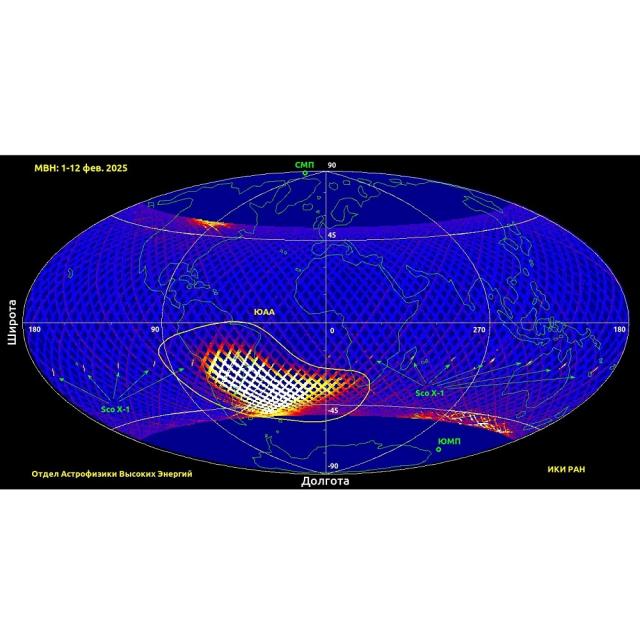
All-Sky Monitor On Its Way To the ISS On August 15, 2024 Soyuz-2.1a rocket launcher blasted off the launch pad at Baikonur cosmodrome carrying Progress MS-28 cargo spaceship to the International Space Station. Its payload includes All-Sky-Monitor X-ray spectrometer, made at IKI, which will study the X-ray background radiation with unprecedented accuracy. Docking to the ISS is scheduled for August 17, 2024.
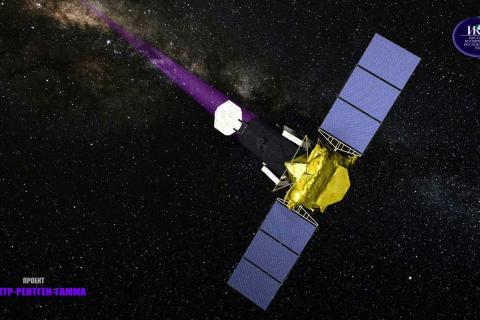
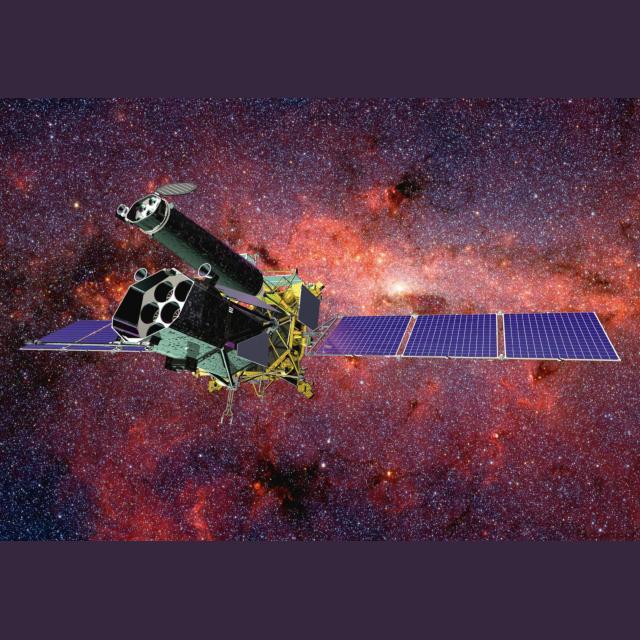
Spektr-RG — Five Years And Counting! On July 13, 2019, Proton rocket launcher with DM-03 booster blasted off from Baikonur cosmodrome, carrying Russian X-ray observatory Spektr-RG. Today, we name some — but by no means the only — fascinating results of its work in these five years.
Pulsar Nebulas And Filaments In the Galactic Centre Galactic Center teems with the most extremal and exotic objects. Among them are so-called filaments — long and thin structures. Some of them are visible in radio, the other — in X-rays. They are supposed to appear as a result of relativistic electrons' and positrons' synchrotron radiation. These particles are born near pulsars — rotating neutron stars with strong magtic fields. New observations support this hypothesis.
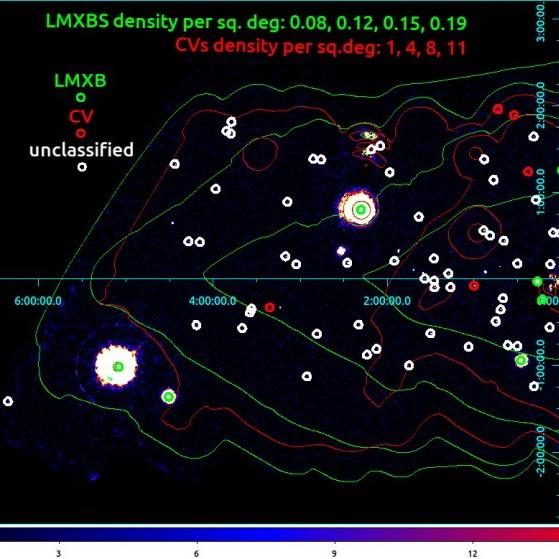
Mikhail Pavlinsky ART-XC Team Publishes New Catalogue of X-Ray Sources Detected During the First Five All-Sky Surveys The new catalogue includes more than one and a half thousand objects. Mikhail Pavlinsky ART-XC telescope is one of the two instruments aboard Russian Spektr-RG space observatory, currently working in L2 point.
Mikhail Pavlinsky ART-XC Telescope Discovers X-Ray Emission of SN2024ggi Supernova SN2024ggi, a II-type supernova, was first found on April 11, 2024 by ATLAS project team. It sits in a nearby galaxy NGC3621. Mikhail Pavlinsky ART-XC telescope onboard Spektr-RG observatory was the first to register its X-ray emission.
New Millisecond X-Ray Pulsar Sounds La As Heard By Mikhail Pavlinsky ART-XC Telescope After the first few days of observations a new X-ray source turned out to be a pulsar in a binary system with a low-mass companion.
X-ray Variability of Quasars Based On SRG/eROSITA All-Sky Survey Data from 2-year sky survey by SRG/eROSITA were used to study X-ray variability of thousands of SDSS quasars. X-ray variability appeared to be linked with some physical parameters of supermassive black holes, such as theirs masses and accretion rates.